Storiesgame lore · AI agents · narrative design · game development · immersion · character consistency
Lore-Accurate AI Agents: Training Models on Game Narrative Canon
Studios are training AI agents on lore and character voices so in-game guidance feels like world-building, not a tutorial pop-up.
YIP Editorial
YIP Founder Growth Lab
August 25, 20265 min read9 reads
Some games hand you a tutorial. The best games make the world itself teach you.
When you get stuck in a modern narrative-driven game, what if the hint came not from a lifeless system message, but from a character who feels like they actually live in that world? That's the real promise of lore-accurate AI agents. Studios are now training machine-learning models on canonical lore, character voices, and narrative tone so that in-game guidance preserves immersion instead of breaking it.
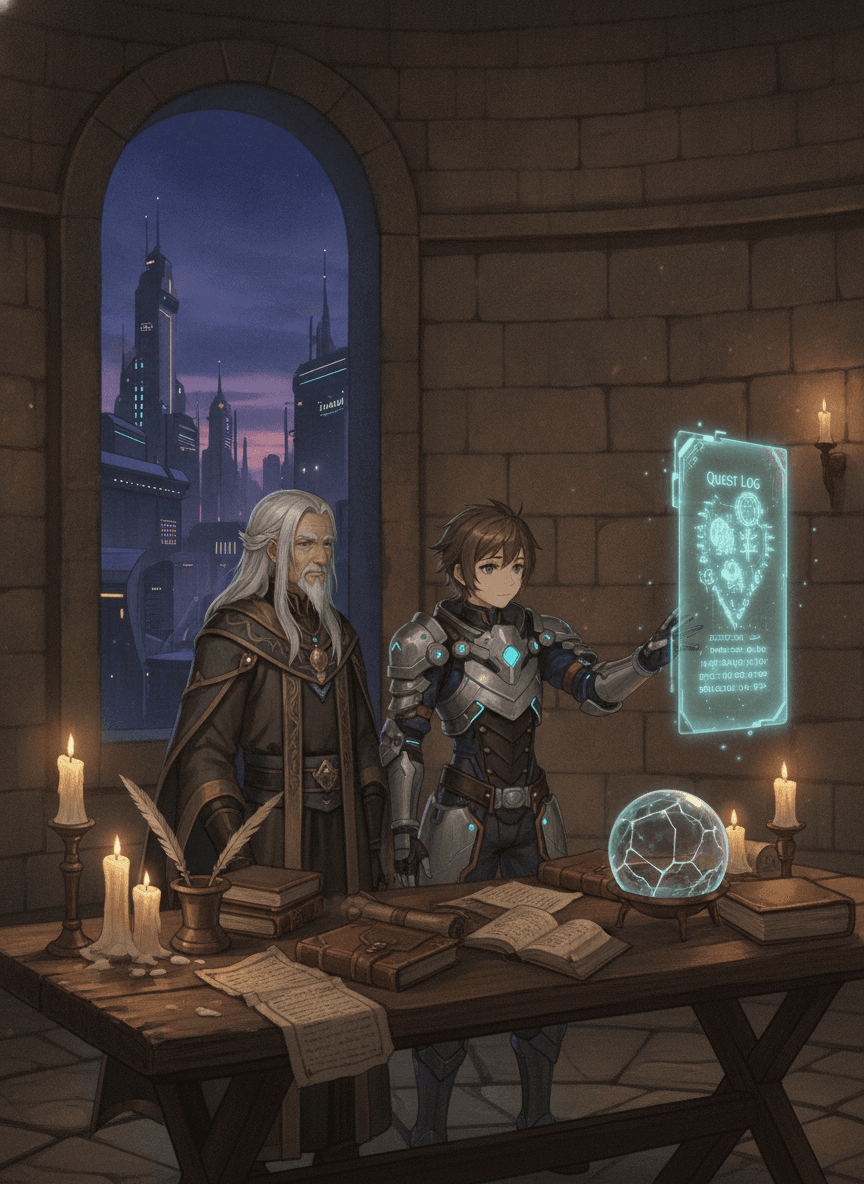
Instead of a disembodied UI whisper, you might ask a magical advisor who speaks in the dialect and cadence of your game's world. The AI didn't just memorize tips; it absorbed your story's DNA.
What Makes an AI Agent Lore-Accurate?
A lore-accurate AI agent is a machine-learning model fine-tuned on a game's canonical narrative, character speech patterns, and world-building rules. It doesn't just answer questions; it answers them as a character would, using language, knowledge, and personality consistent with the game's established fiction.
Think of it this way: a generic help system says "Use your sword combo here." A lore-accurate one might say it through the voice of your mentor, referencing events that happened in Act Two, and phrasing advice in a way that fits their personality and the world's tone.
The difference is felt instantly. One pulls you out of the game. The other deepens your sense of place.
Tip
The goal isn't perfect AI, it's AI consistent enough that players believe it belongs in the world. Small narrative touches (referencing the player's faction, using regional slang, acknowledging past story events) do more than perfect mechanics ever could.
How Studios Build Lore Into Models
Training a lore-accurate AI starts with knowledge graph architecture. Studios map their game's world as a structured database: characters, locations, events, relationships, and rules all linked together. This gives the model a foundation to reason from, not just pattern-match.
A knowledge graph for a fantasy RPG might store that "the Northern Kingdom distrusts magic," so when a player asks for help with spellcasting, the AI can weigh its response through that cultural lens. If the player is aligned with the North, the AI might reframe the same mechanic as a practical utility rather than mystical power.
Fine-tuning techniques layer character voices on top. Studios take hundreds or thousands of canonical lines (from script dialogue, lore books, item descriptions) and use them to teach the model how specific characters actually sound. A cynical rogue doesn't speak like a noble cleric. A centuries-old dragon doesn't think like a newly awakened hero.
Key takeaway
The secret isn't fancy AI, it's treating your game's lore as training data and your world-building as the blueprint for how the system should think and speak.
Prompt Engineering for Narrative Consistency
Raw language models are blank slates. Prompt engineering is how studios shape them into inhabitants of their worlds. A carefully written system prompt tells the model: you are Aria, the forest guardian. You speak in metaphors. You care deeply about wildlife. You distrust outsiders but reward loyalty. Here are 20 things you know about the Grove that no one else does.
When a player asks you a question, respond as Aria would, consulting your internal sense of the Grove's ecology, your character arc through the game, and your relationship to this particular player's faction.
The best implementations weave in dynamic context. The AI knows the player's current quest, their faction standing, items in their inventory, and recent story beats. That makes responses feel genuinely reactive rather than scripted. A lore-accurate AI adapts because it has real awareness of where you are in the story.
Why This Matters for Player Immersion
Immersion breaks the moment a system feels external. Traditional hint systems are external by design, they exist outside the game world, delivering information in a way that only makes sense to the player sitting at the controller.
A lore-accurate AI agent dissolves that boundary. When you ask for help, you're not breaking the fourth wall; you're consulting a character. That changes everything about how guidance lands psychologically.
Players also feel more agency. When a system hints at a puzzle solution, it's static. When a character with opinions and personality offers advice, you can choose to trust them or doubt them. You can roleplay disagreement. The guidance becomes dialogue, not instruction.
Studios using lore-accurate AI have reported higher player satisfaction with in-game tutorials and hint systems. Players spend more time reading AI responses because those responses actually tell stories rather than deliver mechanics.
Real-World Examples in Development
Several AAA studios are quietly experimenting with this. Games with procedurally-generated worlds or emergent narratives are natural fits, imagine an RPG where every NPC's advice is contextually tuned to the world state, your choices, and that NPC's personality.
Narrative-heavy indie titles are also exploring it. When your game's whole appeal is story and character depth, embedding that same depth into your guidance system is the natural next step.
The comprehensive technical approach to deploying lore-accurate AI at scale shows how studios manage costs, latency, and model reliability while keeping the magic intact.
The Technical Reality: Trade-Offs and Challenges
Fine-tuning on game lore demands clean training data. Every line of dialogue, every codex entry, every item description should actually reflect the world as you want it represented. Noisy or contradictory lore training data produces unreliable AI personas.
Latency also matters. If a player asks a question and waits ten seconds for an AI response, immersion shatters. Studios either run lightweight fine-tuned models locally or invest in fast inference pipelines that can respond in under two seconds.
And there's the upkeep problem. Every time you patch lore, add new characters, or retcon story elements, the AI needs retraining or manual prompt updates. It's not a set-it-and-forget-it system.
Warning
A lore-accurate AI that contradicts established canon is worse than no AI at all. Players will notice immediately if the system claims to know something that doesn't fit the story. Consistency is non-negotiable.
Why Gaming Studios Care Now
Player expectations are shifting. Young audiences grew up with AI chat systems; they're comfortable talking to bots. At the same time, they're more attuned to immersion-breaking moments. A help system that feels "off" stands out.
Studios also see efficiency gains. Instead of hiring dozens of human support staff to answer gameplay questions in-game, a well-trained lore-accurate AI can handle a huge volume while keeping every answer aligned with the world's tone. It's not about replacing humans, it's about scaling personality.
The real win is keeping players in the story. Every second a player stays immersed is a second they're not reading a wiki, opening Discord, or alt-tabbing. The game that makes seeking help feel like part of the adventure wins.
Sources: Game Design Patterns (ludology.org), Language Models for Interactive Fiction (OpenAI research), Narrative-Driven Game Development Best Practices